News
News from the tapio app world.

With the redesign of twinio, adding catalog items and individual tools has been revised. The previously nested navigation of tool types has been replaced by a combination of search and filters. Depending on whether the matching catalog item already exists or needs to be newly created, three options are available to you.
1. Select existing catalog item
Search by item number, name, or geometry of your tool. The search includes both catalog items from verified manufacturers and custom catalog items. Select the appropriate item and create the corresponding individual tool. You can then name it.
New: A preview shows you the stored item data so that you can compare it with your physical tool before creating it.
2. Create new catalog item
If the required catalog item does not yet exist, you can create it directly. The new, guided process takes you through the required information in three steps.
3. Scan tool
You can still capture tools using a handheld scanner or the scanner in twinio Mobile. Scan the barcode, QR code, or HEX code to go directly to the catalog item preview and create the individual tool right there.

With the redesign of twinio, the detailed view of catalog items and individual tools has been restructured.
The previous action tab as a central collection of all actions has been removed. Instead, the actions have been placed directly at the respective locations in the detailed view. In addition, the detailed views are structured identically on all end devices in order to facilitate getting started and to make operation familiar more quickly.
You will now find the most frequently used actions directly in the header of the detailed view.
Further actions such as "Connect", "QR code" or "Create own parameter" etc. are located at the respective places where they are needed.
The previous "Analysis" section has also been removed as a separate tab and integrated into the "Process data" section.
Instructions for the individual actions can be found in our Help Center.
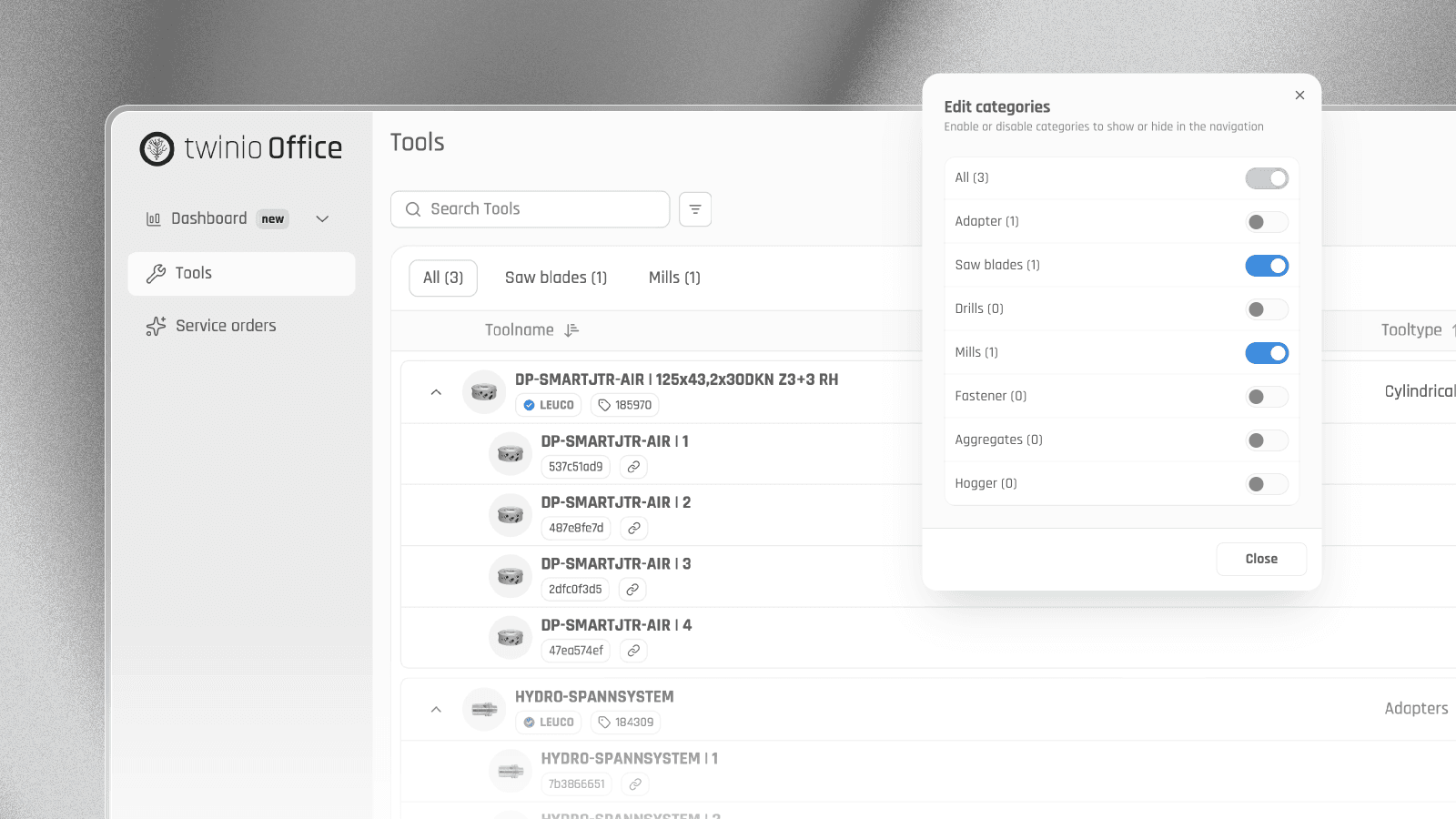
With the redesign of twinio, the tool overview has also been revised. Due to the growing number of tool types, the previous tree structure had over time become a deeply nested folder structure, which sometimes required long navigation paths.
Therefore, the tree structure has been replaced by tabs for the different tool types. This allows catalog items and the corresponding individual tools to be reached more quickly.
The tabs can be shown and hidden individually. This means that only the tool types that are actually required can be displayed directly in the overview.
What remains: Search and filters continue to function as usual and display only individual tools as search results. The hierarchy between catalog items and individual tools also remains.
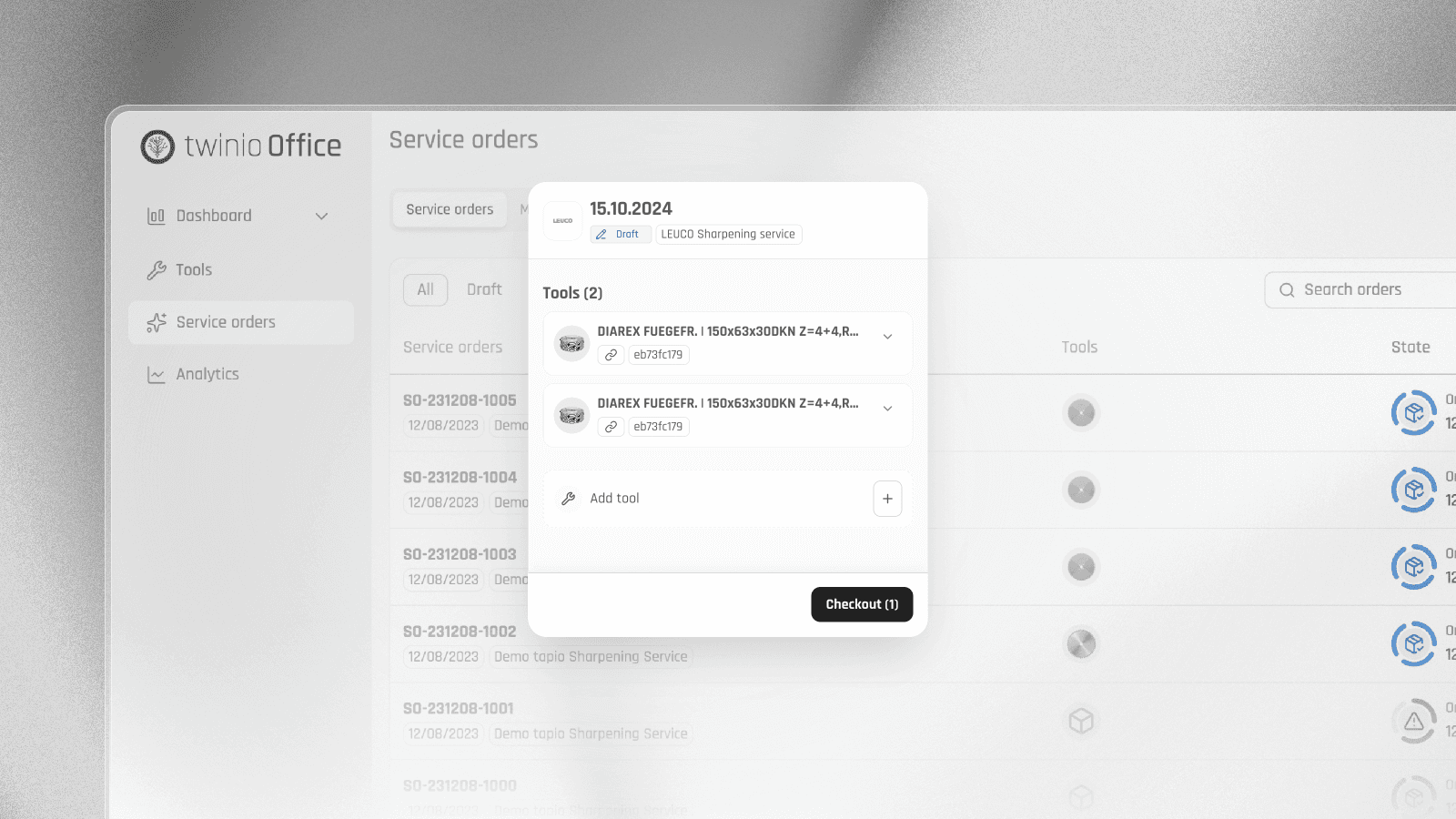
Starting now, you can find all your sharpening orders centrally in twinio under the "Service Orders" section. This applies both to manually created sharpening orders without an add-on and to orders created via a sharpening service.
The creation of sharpening orders has also been fundamentally revised. With the new process, you can first collect blunt tools in multiple drafts and then start a sharpening order bundled together.
You can now create sharpening orders directly under the menu item Service Orders. Individual tools can still be added directly from the tool overview.
All other functions, as well as existing sharpening orders created via a sharpening service, will remain intact.
Detailed instructions on the new process can be found in our Help Center.